
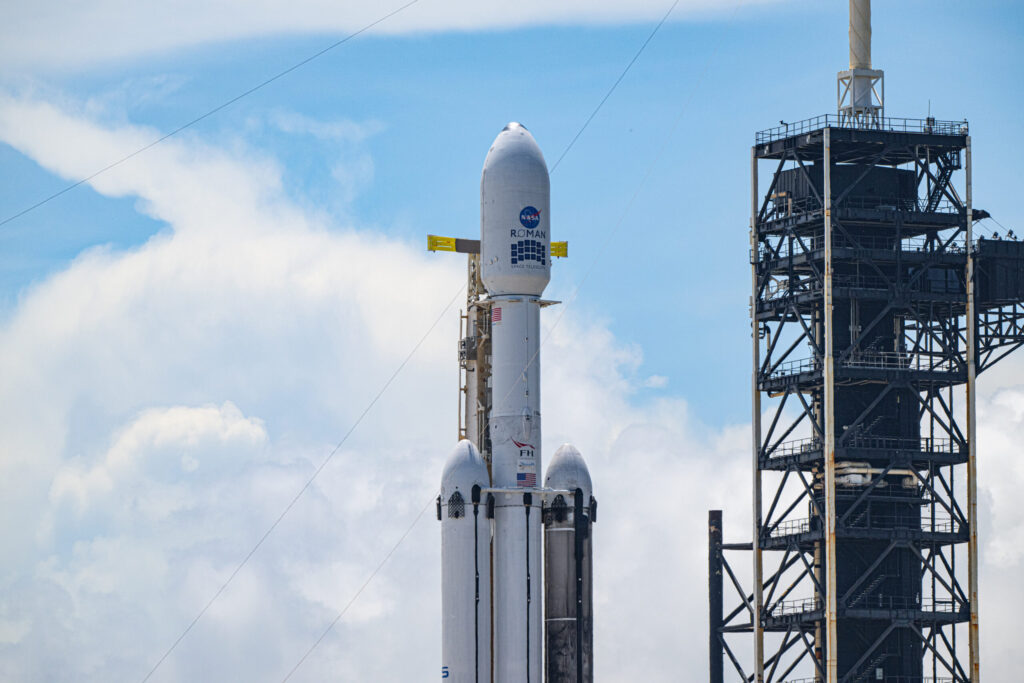
NASA has successfully launched the Nancy Grace Roman Space Telescope, a $4.3 billion observatory designed to investigate some of astronomy’s biggest mysteries, including dark matter, dark energy and planets beyond our solar system. Remarkably, part of the telescope’s technology was originally developed for American spy satellites before being repurposed to look outward into the universe instead of down at Earth.
The Roman telescope lifted off from Florida on August 30 aboard a SpaceX Falcon Heavy rocket. The successful launch begins a mission expected to operate for at least five years from a location roughly one million miles from Earth, near the second Sun-Earth Lagrange point, known as L2.
Roman represents a different approach to astronomy than NASA’s Hubble and James Webb space telescopes. Rather than concentrating primarily on extremely narrow sections of the sky, Roman is designed to survey enormous areas rapidly while still producing remarkably detailed infrared observations.
Its primary scientific instrument is the Wide Field Instrument, a 300-megapixel infrared camera and spectrometer. Roman’s primary mirror is 2.4 meters across—the same diameter as Hubble’s—but its field of view is dramatically larger. NASA says the observatory will be capable of surveying vast portions of the universe far faster than Hubble could.
That combination of resolution and scale could transform astronomers’ understanding of the cosmos.
Roman will observe enormous numbers of galaxies to investigate dark matter and dark energy, two mysterious components believed to dominate the universe. Scientists can see the gravitational effects of dark matter but still do not know what it actually consists of. Dark energy is even more mysterious and is believed to be responsible for the accelerating expansion of the universe.
By measuring the positions, shapes and distances of huge numbers of galaxies—and observing phenomena such as supernovae and gravitational lensing—Roman could help scientists reconstruct how the universe evolved and test competing theories about cosmic expansion.
The observatory will also become a powerful planet hunter.
Roman will monitor hundreds of millions of stars for tiny changes in brightness that can reveal planets orbiting distant stars. Scientists expect its surveys to dramatically increase the number of known exoplanets and potentially uncover planetary systems unlike anything previously observed.
A second instrument, the Coronagraph Instrument, represents another important technological experiment. It uses sophisticated mirrors and optical systems to suppress the overwhelming brightness of stars so astronomers can attempt to directly image much fainter planets orbiting nearby.
If successful, the technology could help prepare NASA for future observatories capable of studying Earth-like planets and eventually analyzing their atmospheres for potential signs of habitability.
One of Roman’s most unusual features, however, comes from its connection to America’s intelligence community.
The telescope incorporates mirror technology originally developed for the National Reconnaissance Office, the secretive U.S. intelligence agency responsible for operating reconnaissance satellites. The NRO donated telescope hardware to NASA more than a decade ago, allowing scientists and engineers to transform technology originally intended for surveillance into an astronomical instrument.
Roman also survived political uncertainty before reaching space. The Trump administration had previously proposed eliminating the telescope in budget plans as part of broader efforts to reduce spending on NASA science programs. Congress continued supporting the mission, however, allowing development to proceed.
The telescope ultimately reached the launchpad ahead of NASA’s formal May 2027 launch-readiness commitment and within its approximately $4.3 billion life-cycle budget.
Named after Nancy Grace Roman, NASA’s first chief astronomer and a pioneering advocate for space-based astronomy, the observatory could become one of the agency’s most scientifically productive missions.
Hubble revolutionized astronomy by providing extraordinary detailed views of relatively small regions of space. James Webb pushed humanity’s vision deeper into the infrared universe. Roman’s strength will be different: combining sharp observations with an enormous panoramic view, allowing astronomers to study the universe statistically on a scale that previous space telescopes could not achieve.
A technology once designed to help American intelligence agencies observe Earth will now spend years looking in the opposite direction—mapping galaxies, searching for distant worlds and potentially revealing entirely new clues about how the universe works.