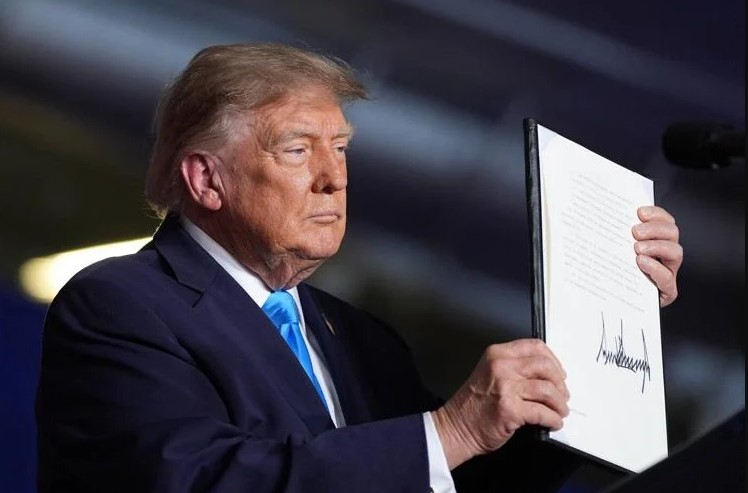
President Donald Trump is heading to Nebraska to campaign for Republican Sen. Pete Ricketts, bringing his midterm push into one of the country’s most reliably conservative states at a moment when economic frustration and anger over agricultural policy are creating unexpected political pressure.
Trump is scheduled to appear in Grand Island, Nebraska, as part of what he has described as a 32-day campaign blitz ahead of the November 3 midterm elections.
Ricketts, a former Nebraska governor, is seeking his first full six-year Senate term. He originally entered the Senate after being appointed to replace Ben Sasse in 2023 and later won an election to remain in the seat.
His opponent is independent candidate Dan Osborn, a former labor union leader who previously challenged Republican Sen. Deb Fischer in 2024 and lost by seven percentage points.
The 2026 contest was initially expected to be relatively comfortable for Republicans, but it has attracted increasing national attention as Democrats and allied groups look for opportunities in states that normally favor the GOP.
Osborn has deliberately maintained his independent identity rather than running as a Democrat, a potentially important strategy in deeply conservative Nebraska. National Democrats support his candidacy, but he has not committed to caucusing with either party if elected.
Trump’s appearance is intended to reinforce Republican turnout and support for Ricketts.
But the visit comes amid an uncomfortable policy dispute involving one of Nebraska’s most important industries: cattle ranching.
The Trump administration has proposed allowing more foreign beef imports in an effort to reduce high beef prices for American consumers.
Nebraska ranchers have strongly criticized the idea, arguing that additional imports could depress prices for domestic cattle producers while doing little to address the deeper structural causes of high beef costs.
Ricketts himself has publicly broken with the White House on the issue.
He said that importing lower-quality foreign beef would not help Nebraska ranchers and urged the administration to focus instead on long-term policies that would expand the size of the U.S. cattle herd and eventually lower prices through greater domestic supply.
The dispute illustrates the political difficulty of addressing food inflation.
Consumers want lower grocery bills, but policies designed to increase cheaper imports can anger domestic producers who fear losing income or market share.
The broader economic environment is also challenging.
Across the country, voters remain concerned about persistent high costs for fuel and groceries, creating pressure on Republican candidates as Trump campaigns on behalf of the party.
Nebraska’s Senate race is therefore becoming part of a larger pattern in the 2026 midterms.
Independent candidates are also challenging Republican senators in conservative states including South Dakota and Idaho, reflecting efforts to compete in places where the Democratic label remains unpopular.
Nebraska itself has another closely watched contest in the Omaha area, which is significantly more competitive politically than the rural and heavily Republican Grand Island region where Trump will appear.
For Ricketts, Trump’s visit provides a chance to energize conservative voters and reinforce the senator’s connection to the Republican president.
At the same time, the beef-import controversy shows that political loyalty does not necessarily eliminate disagreements over economic policy, especially when those policies directly affect farmers and ranchers.
Trump’s Nebraska stop therefore highlights two competing forces shaping the midterms: the continuing importance of his support among Republican voters and growing economic frustration that is making even traditionally safe states more politically complicated than party leaders once expected.