
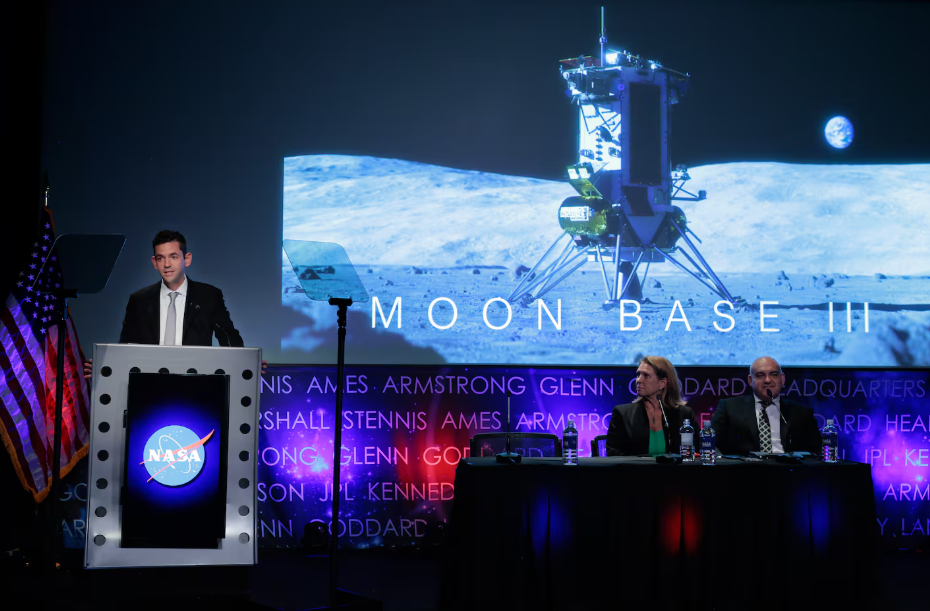
NASA has revealed new details about its plan to build the first phase of a permanent moon base, marking a major step in the Artemis program’s effort to return astronauts to the lunar surface and eventually create a lasting human presence there. The agency is moving ahead after the Artemis II flyaround of the moon and has awarded contracts worth hundreds of millions of dollars to U.S. companies that will supply the first equipment needed before astronauts arrive.
The initial focus is practical: NASA wants landers, moon buggies and drones on the surface first. Blue Origin is expected to deliver landers that can carry rover vehicles developed by Astrolab and Lunar Outpost, while Firefly Aerospace will provide the first moon-bound drones. These machines are intended to be deployed near the moon’s south pole, the region NASA considers most important because it may contain water ice that could support astronauts and future missions.
The south pole is central to NASA’s long-term vision. Water ice could potentially be used for drinking water, oxygen, and rocket fuel, making it one of the most valuable resources for future deep-space exploration. NASA describes the moon base as a home for Artemis astronauts who will live and work at humanity’s first lunar outpost, with the agency leading international, commercial and academic teams to create an enduring presence there.
The plan is divided into phases. Artemis III is targeted for mid-2027, with a crewed lunar landing by two astronauts potentially following as soon as 2028. That mission would involve docking maneuvers in Earth orbit with landers from Blue Origin and SpaceX. The second phase, beginning in 2029 and continuing into the early 2030s, would focus on more permanent infrastructure, including a lunar power grid. A third phase in the 2030s would aim to support astronauts for extended stays in specialized permanent habitats.
The contracts also show NASA’s growing dependence on private space companies. Instead of building every system itself, the agency is using commercial partners to develop landers, rovers, drones and other infrastructure. This approach is meant to reduce costs, speed innovation and create a lunar economy in which private companies can eventually provide services for NASA, other governments and possibly commercial customers.
The project is also geopolitical. The United States wants to maintain leadership in space as China advances its own lunar ambitions. Establishing infrastructure near the moon’s south pole would give NASA and its partners an early advantage in a region expected to become increasingly important for science, resources and future exploration.
Overall, NASA’s moon base plan shows that Artemis is no longer just about landing astronauts for short visits. The goal is to build a working lunar outpost with vehicles, power, landing systems and eventually habitats. It is an ambitious and difficult project, but it represents NASA’s clearest path toward making the moon a base for science, industry and future missions to Mars.