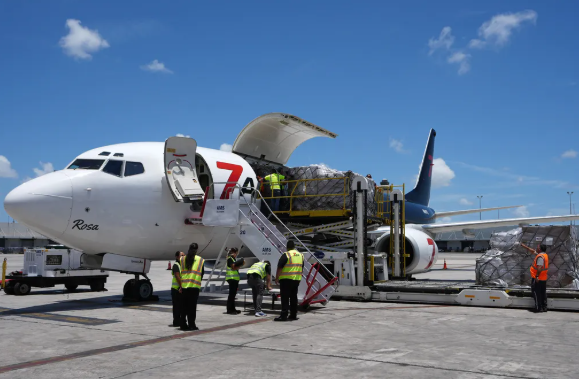
The United States has dispatched a cargo plane carrying food and hygiene supplies to Cuba as part of a humanitarian initiative designed to assist ordinary residents without placing the aid under the control of the Cuban government. The shipment comes as Washington simultaneously intensifies economic and political pressure on Havana, creating a policy that combines direct civilian assistance with tougher measures against the island’s communist leadership.
The aircraft departed Miami carrying 700 packages of essential goods. According to the U.S. State Department, Catholic organizations and local priests in Cuba will distribute the supplies directly to families and communities. American officials say this arrangement is intended to prevent Cuban authorities from intercepting, redirecting or controlling the assistance. The strategy reflects Washington’s effort to distinguish between support for the Cuban population and opposition to the country’s government.
The flight represents the first portion of a broader $100 million aid commitment previously offered by the United States. Tuesday’s shipment was described as a $60 million initial tranche. It follows an earlier American program that provided approximately $9 million in direct assistance after Hurricane Melissa. U.S. officials said that experience helped establish the partnerships and distribution mechanisms being used for the latest delivery.
Jeremy Lewin, the State Department official responsible for foreign assistance, humanitarian affairs and religious freedom, said negotiations with Havana had been difficult. Washington wanted assurances that the Cuban government would permit the supplies to enter the country and would not seize them. Because Catholic groups are managing distribution, Lewin said the authorities should have little opportunity to interfere.
Catholic Relief Services President and CEO Sean Callahan recently traveled to Cuba to examine how the assistance would be handled and to reinforce accountability. He described the shipment as a modest but potentially constructive humanitarian step that could help bring Cubans and Americans closer together, despite the governments’ deeply adversarial relationship.
The aid arrives during one of Cuba’s most severe economic and social crises in decades. Energy shortages, limited access to imported goods and deteriorating public services have disrupted daily life. U.S. sanctions and an energy and oil blockade have contributed to the paralysis of the Cuban economy, while Washington argues that its measures are directed primarily at the military, intelligence services and other institutions supporting the government.
At the same time, the Trump administration has increased its political campaign against Havana. The State Department recently accused Cuba of operating an extensive espionage and ideological influence network inside the United States. Secretary of State Marco Rubio, whose parents emigrated from Cuba, has taken a central role in demanding changes to the island’s socialist political system. President Donald Trump has also raised the possibility of stronger action against the Cuban government.
Cuban officials have criticized the American approach. Foreign Minister Bruno Rodríguez previously dismissed delayed aid promises as unrealistic and argued that the proposed $100 million was small compared with Cuba’s daily economic losses resulting from U.S. sanctions and restrictions.
Overall, the shipment illustrates Washington’s dual strategy toward Cuba: provide visible assistance directly to people experiencing hardship while attempting to isolate and weaken the government. The initiative may offer short-term relief, but it is unlikely to resolve the larger crisis, which remains deeply connected to domestic economic failures, international sanctions and decades of hostile relations between the two countries.