
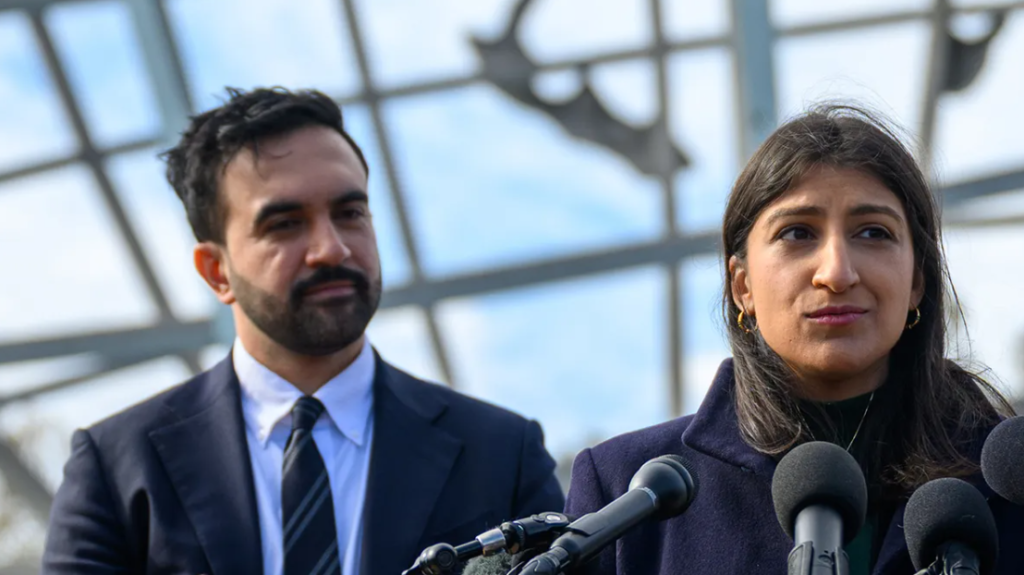
New York City Mayor Zohran Mamdani has chosen former Federal Trade Commission Chair Lina Khan to lead the board of the New York City Economic Development Corporation, a surprising appointment that places one of America’s most prominent critics of corporate concentration at the center of the city’s development strategy. Mamdani also named veteran public official Anthony “Tony” Shorris as the corporation’s president and chief executive, creating an unusual leadership partnership that combines progressive economic reform with extensive experience in government and business.
The Economic Development Corporation plays a major role in shaping New York’s economy. The quasi-public organization manages city-owned property, negotiates real-estate agreements, oversees infrastructure and construction projects, administers incentives and works to attract industries and private investment. It controls roughly 60 million square feet of property and manages around 100 active construction projects valued at approximately $6 billion. That makes its leadership highly influential in decisions involving housing, waterfront redevelopment, industrial land, technology investment and neighborhood development.
Khan became a nationally recognized figure through her aggressive approach to antitrust enforcement. As FTC chair during the Biden administration, she challenged major mergers and sought to expand government scrutiny of powerful corporations, particularly technology companies. Her policies earned strong support from consumer advocates, labor groups and progressive politicians, but drew criticism from Wall Street, Silicon Valley and business organizations that viewed her as overly hostile to large enterprises.
Her appointment therefore startled parts of New York’s business community. Economic-development agencies have traditionally focused on attracting companies, approving major projects and encouraging private investment. Khan’s background suggests that the Mamdani administration wants the corporation to consider competition, affordability, worker interests and public benefit more directly when deciding how land, incentives and city resources are used.
However, Khan will chair the board rather than manage the corporation’s daily operations. Shorris, as president and CEO, will be responsible for running the organization and implementing its programs. A longtime city official with experience under several mayoral administrations, Shorris has worked on affordable housing, universal prekindergarten and other major public initiatives. He is widely regarded as a pragmatic administrator with strong relationships across government, real estate and the business community. His selection appears intended to balance Khan’s reform-oriented reputation and reassure investors that the administration still values practical collaboration.
The combination has nevertheless produced uncertainty about who will exercise the greatest influence. The board chair usually has less direct authority than the president, but Khan could still shape the corporation’s broader priorities, influence major agreements and establish standards for public subsidies and development projects. Business leaders will watch closely to see whether she adopts a confrontational approach toward large companies or works with Shorris to develop a more cooperative strategy.
Mamdani’s administration has said the new leadership reflects a broader effort to redefine economic development around economic justice. Deputy Mayor Julie Su has emphasized that growth should deliver affordable housing, strong employment opportunities and tangible benefits to communities that have historically been overlooked. Under this vision, success would not be measured only by the amount of private capital attracted or the number of luxury buildings constructed.
The new team will face immediate pressure to advance major projects, including the approximately $3.5 billion redevelopment of the Brooklyn Marine Terminal. Developers and business groups are seeking clarity after months of uncertainty about the administration’s economic plans, while progressive supporters expect stronger conditions on subsidies, wages and community benefits.
Overall, Khan’s appointment is both symbolic and consequential. It signals that Mamdani wants New York’s economic-development machinery to challenge concentrated corporate power and address the affordability crisis. Whether the strategy succeeds will depend on Khan and Shorris’s ability to unite reform with investment, move complicated projects forward and convince both communities and businesses that development can produce broader public benefits.