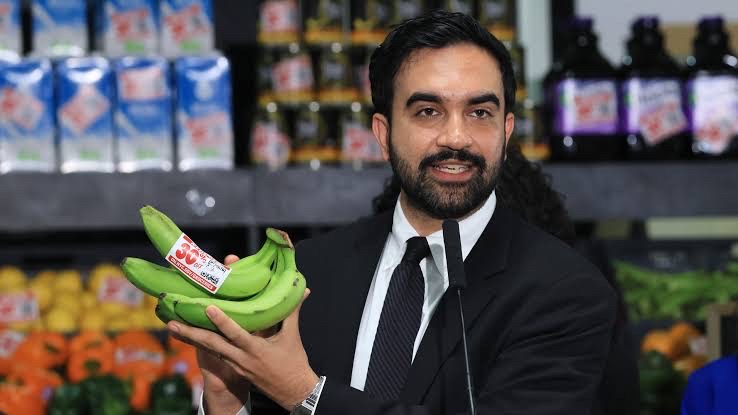
New York City Mayor Zohran Mamdani plans to establish five city-owned grocery stores—one in each borough—as part of his broader effort to reduce the cost of living. The proposed markets would offer discounts of approximately 30% on essential products such as meat, seafood, milk and bread. Although the city would own the stores and control their pricing and employment standards, private grocery companies would manage their daily operations.
The initiative has become a prominent test of whether public ownership can make food more affordable in an expensive city. Supporters view the stores as a practical alternative to profit-driven retail, arguing that removing rent, property taxes and shareholder returns could allow the government to sell basic goods at lower prices. Progressives also see the proposal as an opportunity to demonstrate that public institutions can directly improve residents’ daily lives.
However, the question is whether Mamdani’s approach is the most effective use of public money. Public grocery stores have traditionally been created in rural towns or underserved neighborhoods where private retailers have completely withdrawn. New York faces a different situation: It already has more than 1,100 supermarkets and roughly 10,000 bodegas. While some communities still have limited access to healthy food, the planned locations are not necessarily concentrated in the city’s most severe food deserts. One proposed East Harlem store, for example, would operate near existing retailers, including Aldi and Costco.
The central economic concern is that the stores may achieve low prices by operating at a financial loss rather than through genuine efficiencies. Grocery retail is already a low-margin business, with average industry profits estimated at just over 2%. Eliminating profits alone therefore would not be enough to finance discounts approaching 30%. The city also wants its stores to pay comparatively high wages and potentially prioritize local or regional suppliers, policies that may be socially desirable but could increase operating expenses.
The stores would avoid rent and property taxes because they would operate in publicly owned buildings. Yet, this represents another subsidy rather than an actual cost-saving innovation. The city would give up revenue it could otherwise use for food assistance, public services or other priorities. If heavily discounted products attract large crowds, the stores might also need frequent restocking, potentially increasing annual taxpayer losses.
The city estimates that launching the five locations will require about $70 million in capital spending, although their future operating costs remain unclear. In the context of New York’s roughly $125 billion budget, the pilot is relatively small. Nevertheless, critics emphasize the opportunity cost: The same money could expand food banks, provide direct cash assistance or strengthen programs such as Get the Good Stuff, which gives SNAP recipients discounts when purchasing fruits and vegetables.
Another alternative would be loosening zoning and permitting restrictions that make it difficult for large discount retailers to open additional stores in New York. Increased competition from companies capable of purchasing and distributing food at enormous scale could potentially lower prices without requiring permanent public subsidies. Mamdani’s own policy materials acknowledge that regulatory reform could form part of the city’s affordability strategy.
Despite these criticisms, the stores could still function as community spaces or visible public amenities, much like parks and libraries. Successful locations might also increase residents’ confidence that local government can provide useful, affordable services. But the experiment carries political risks: overcrowding, shortages or persistent financial losses could instead reinforce doubts about government efficiency.
Mamdani’s proposal may provide meaningful savings to shoppers who live or work near the five stores, but it is unlikely to substantially reduce grocery prices across the entire city. The central debate is not whether public markets can offer cheaper food—they can, through subsidies—but whether they can deliver broader benefits more effectively than direct assistance, stronger competition or expanded anti-hunger programs.