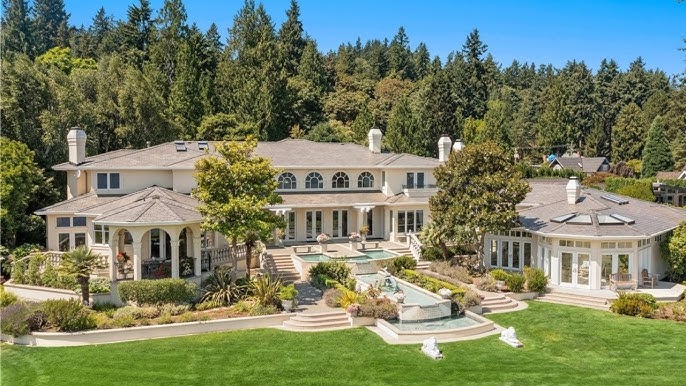
Washington, D.C.’s luxury real-estate market is experiencing an unusual surge as billionaires, technology executives, finance leaders and prominent members of President Donald Trump’s administration compete for some of the capital region’s most prestigious homes. Once known for a relatively stable high-end market dominated by political figures, lawyers and longtime Washington families, the city is increasingly attracting buyers whose enormous fortunes are pushing trophy-home prices to unprecedented levels.
The transformation is particularly striking because some housing analysts initially expected Trump’s return to Washington and his campaign to shrink the federal workforce to weaken the region’s property market. Instead, the uppermost tier has moved in the opposite direction. Wealthy newcomers connected to technology, private equity, professional sports and the administration are purchasing estates in Northwest Washington, Montgomery County, Maryland, and Northern Virginia, creating intense competition for properties that combine privacy, security, historical significance and proximity to political power.
Among the most notable transactions is billionaire investor and Washington Commanders owner Josh Harris’s $28 million purchase of Halcyon House, an historic Georgetown property dating to the late 18th century. The transaction set a record for a Washington, D.C., home and illustrates how dramatically the ceiling of the local luxury market has risen. Harris, a co-founder of Apollo Global Management, plans to return the landmark property to use as a single-family residence.
Other extremely wealthy buyers have also established significant residential footprints in the region. Commerce Secretary Howard Lutnick purchased a roughly $25 million property in 2024, while Meta chief executive Mark Zuckerberg paid about $23 million for a 25,000-square-foot residence in 2025. Their purchases demonstrate how Washington increasingly competes with traditional billionaire destinations such as New York, Miami and California for elite residential buyers.
For these buyers, owning a Washington residence is not necessarily just a lifestyle decision. Proximity to the White House, Congress, regulators and other influential institutions can have strategic value for executives whose companies and investments are heavily affected by federal policy. Luxury real-estate broker Daniel Heider said that even a relatively small improvement in a powerful executive’s effectiveness or influence could justify purchasing a home and becoming more embedded in the Washington community.
The trend also illustrates the growing separation between the ultra-luxury market and ordinary housing conditions. Nationally, luxury home prices have shown signs of cooling: the threshold for the top 10% of U.S. listings was approximately $1.27 million in April 2026, down 1.9% from a year earlier. Yet markets attracting exceptionally wealthy buyers can behave very differently because these purchasers are less dependent on mortgage rates and ordinary affordability conditions.
Washington’s supply of true trophy properties is also inherently limited. Historic Georgetown mansions, large estates in prestigious Northwest neighborhoods and highly private properties close to the capital cannot easily be reproduced. When several billionaires pursue the same small group of residences, that scarcity can produce record-breaking transactions even while the broader regional housing market remains far more restrained.
The phenomenon fits a wider national pattern in which enormous fortunes generated through technology, finance and artificial intelligence are reshaping elite real estate. Ultra-wealthy buyers have recently driven extraordinary transactions in markets ranging from San Francisco to South Florida, demonstrating how wealth creation at the very top can transform individual neighborhoods independently of broader housing trends.
Washington is emerging as a new billionaire real-estate destination. Political influence, technology wealth and financial power are converging in the capital, creating extraordinary demand for a limited number of prestigious properties. The result is a luxury market increasingly defined not simply by traditional Washington wealth, but by some of America’s richest and most influential people competing for a place close to the center of national power.