
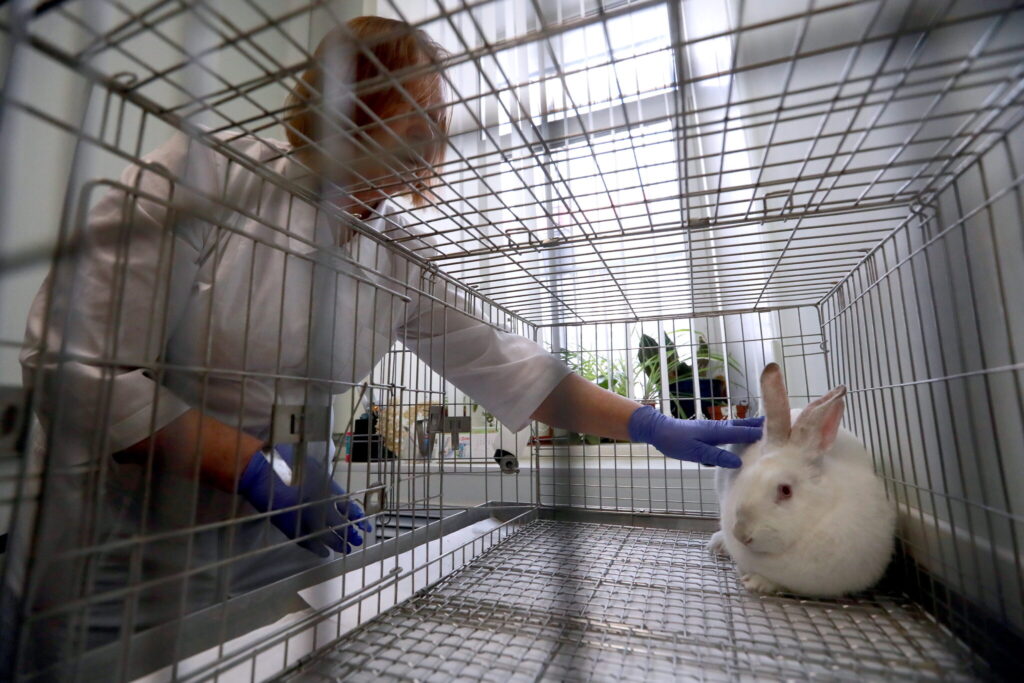
The U.S. Department of Health and Human Services is accelerating a major transformation in biomedical research, launching new initiatives intended to reduce reliance on animal testing while expanding the use of human cells, organoids, organs-on-chips, artificial intelligence and computational models in drug development.
The effort represents one of the federal government’s most significant moves toward so-called New Approach Methodologies, or NAMs, which researchers hope can sometimes predict human responses to medicines more accurately than traditional animal experiments.
One of the most important changes comes from the Food and Drug Administration.
The FDA issued a final rule replacing regulatory references to “animal tests” and “animal studies” with the broader terms “nonclinical tests” and “nonclinical studies.” The change formally recognizes that drug developers can use scientifically valid alternatives to animal experiments when appropriate.
Those alternatives can include cell-based assays, organ chips, microphysiological systems, computer modeling and bioprinting.
The FDA emphasized that the rule does not prohibit animal studies or lower existing standards for demonstrating drug safety. Instead, it removes regulatory language that could imply animal experiments are the only acceptable approach.
The National Institutes of Health is simultaneously investing heavily in the infrastructure needed to make these alternatives practical.
NIH announced more than $88 million for 10 biomedical infrastructure projects across the country. It is also offering more than $7 million through a competition exploring quantum-enabled technologies that could improve laboratory-based NAMs.
Another initiative will establish a specialized laboratory at the NIH Clinical Center combining standardized human organoids with robotics, artificial intelligence and advanced data systems.
Human organoids are miniature laboratory-grown structures designed to reproduce important characteristics of actual organs. Combined with sophisticated computational models and automated experiments, researchers hope these technologies can provide a more direct picture of how human biology responds to diseases and potential medicines.
The shift reflects a longstanding problem in pharmaceutical research: results observed in animals frequently fail to translate directly to humans.
Animal experiments have contributed enormously to medical science and remain important in many areas, but biological differences between species can limit their predictive power. STAT notes that studies have estimated roughly 90% of drugs that appear safe and effective during early animal testing ultimately fail to perform as hoped during human development.
Federal officials argue that better human-based models could therefore achieve two objectives simultaneously: reduce the number of animals used in laboratories and improve the efficiency of drug development.
HHS says its agencies have launched more than 20 initiatives related to reducing animal testing since Robert F. Kennedy Jr. became health secretary.
NIH has also created the Office of Research Innovation, Validation, and Application to coordinate the development and validation of human-based technologies. The agency is recruiting scientific grant reviewers with expertise in these methods and examining whether it can publish annual reports tracking vertebrate-animal use in NIH-funded research.
However, replacing animal experiments will not happen immediately.
New methods must demonstrate that they are reliable, reproducible and capable of providing regulators with sufficient evidence about potential toxicity and safety. In some scientific areas, validated alternatives may not yet exist.
The policy therefore represents a gradual transition rather than an immediate elimination of animal research.
Its significance could nevertheless be substantial.
If human organoids, organs-on-chips, AI and computational models prove more predictive, pharmaceutical companies could identify ineffective or dangerous experimental medicines earlier, potentially reducing development costs and preventing unsuccessful drugs from advancing into expensive human trials.
The broader objective is to change the foundation of preclinical medicine: rather than relying primarily on animals as proxies for people, researchers would increasingly begin with models designed around human biology itself.
If successful, the transformation could simultaneously reduce animal use, accelerate drug development and provide scientists with more accurate tools for predicting how experimental treatments will actually behave in patients.