The International Monetary Fund has lowered its global growth outlook and warned that the world economy is already drifting toward a more dangerous path as the war tied to Iran continues to disrupt energy markets. In a report, the IMF presented three scenarios for the global economy, all shaped by how long the conflict lasts and how severely it affects oil shipments through the Strait of Hormuz. While the fund’s official forecast uses the least damaging case as its baseline, its chief economist said current conditions already appear closer to the more adverse scenario.
In its reference forecast, the IMF assumes the conflict is relatively short-lived and that oil prices ease later in 2026, averaging about $82 a barrel for the year. Even under that more optimistic case, the IMF still cut its growth outlook because the war has already raised energy costs and uncertainty. The fund said, absent the conflict, it would actually have upgraded global growth by 0.1 percentage point to 3.4% thanks to strong technology investment, lower interest rates, less severe U.S. tariffs, and fiscal support in some countries. Instead, that improvement has been erased by the economic shock from the Middle East.
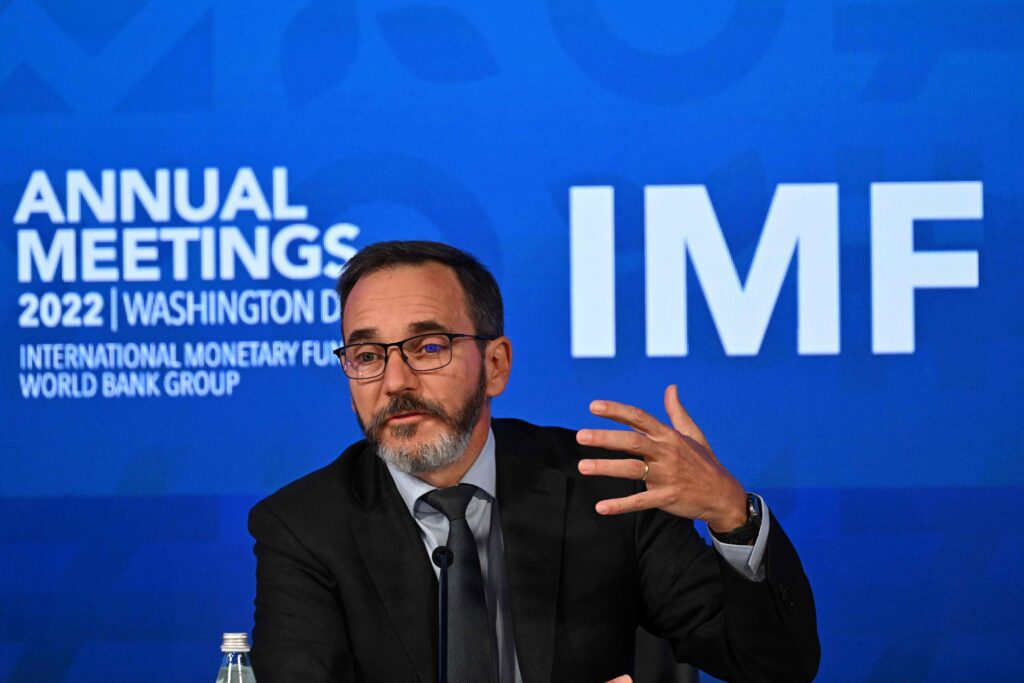
The bigger concern is the IMF’s warning that reality may already be moving beyond that relatively mild baseline. Chief economist Pierre-Olivier Gourinchas told reporters that with continued energy disruption and no clear path to ending the conflict, the world is drifting toward the fund’s adverse scenario. The middle-case scenario assumes a longer conflict, oil at around $100 a barrel in 2026, and global growth falling to 2.5% this year, down from 3.4% in 2025. That would represent a meaningful slowdown for the world economy, especially after earlier hopes that growth might strengthen.
The IMF’s most severe scenario is even more troubling. In that case, the war deepens, financial markets are disrupted more sharply, and oil averages $110 a barrel in 2026 and $125 in 2027. Global growth would fall to 2.0%, which the IMF described as a near-global-recession outcome. The fund noted that world growth has dropped below that level only four times since 1980, including during the 2009 financial crisis and the 2020 pandemic recession. Gourinchas said some countries would be in outright recession under this severe scenario.
Inflation is a major part of the danger. The IMF warned that a long period of higher oil prices could convince households and businesses that inflation is becoming permanent, which could then trigger broader price increases and demands for higher wages. Gourinchas said that if inflation expectations shift in that way, central banks may have to tighten policy more aggressively, potentially causing more economic pain than in 2022. Also, governments may be tempted to use broad fuel subsidies or price caps to soften the blow, but the IMF cautioned against that approach because many countries already face high deficits and debt. Instead, it urged temporary and targeted support for vulnerable groups.
The impact is not evenly distributed. The Middle East and Central Asia are among the hardest-hit regions, while the euro zone is also expected to suffer a notable growth slowdown because of its dependence on imported energy. Even if the conflict is resolved quickly, the IMF expects euro zone growth in 2026 to slow to 1.1%, down from 1.4% in 2025, while inflation rises to 2.6%. India stands out as a relative bright spot, with growth forecasts of 6.5% for both 2026 and 2027.
Overall, the IMF’s message is that the world economy is still functioning, but the margin for safety is narrowing fast. The baseline forecast may still assume a contained conflict, yet the fund’s own public comments suggest that outcome is becoming less likely by the day. If energy disruptions through Hormuz continue and oil remains elevated, the global economy could move from a slowdown toward something much more serious.