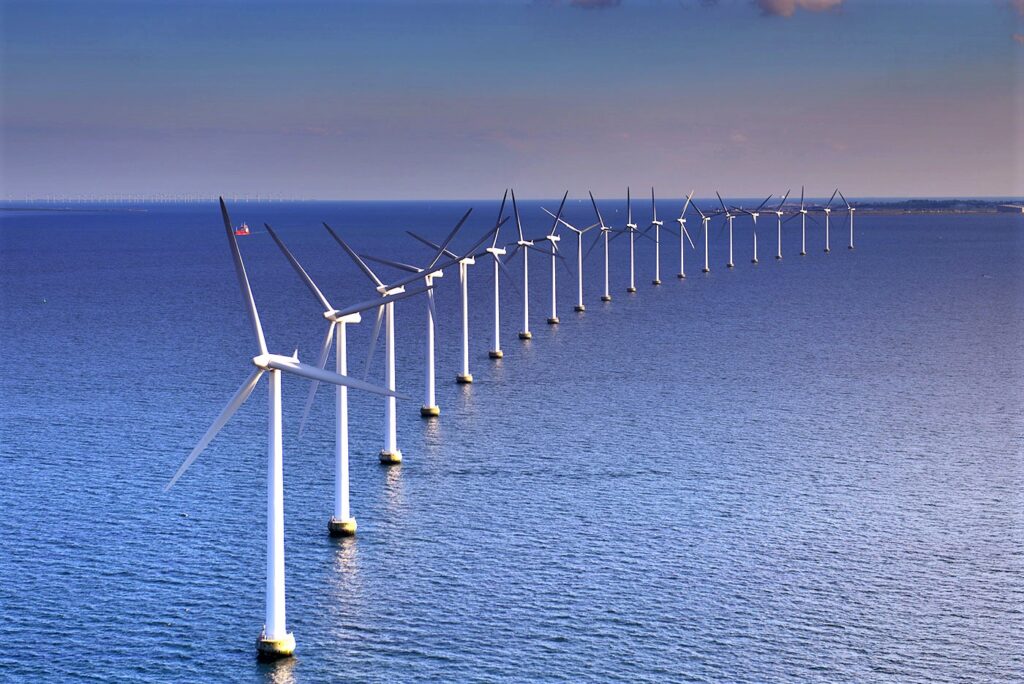
Offshore wind projects are continuing to take shape along the U.S. East Coast even as President Donald Trump tries to stop the American offshore wind industry from moving forward. Seemingly, there are three of the five wind farms in the region, two fully operational, two nearly complete, and one about halfway built. The physical build-out of offshore wind is already far enough along that the industry remains visibly active, even under a hostile White House.
The turbines off Rhode Island are enormous, roughly three times the height of the Statue of Liberty, and are already delivering clean electricity to the region. The attention is centered on Revolution Wind, whose central hub or substation was active offshore, and on Sunrise Wind, where construction was said to be nearly 50% complete. These details matter because they show the industry is not just a future promise. In several places, it is already operating or close to operation.
Revolution Wind and Sunrise Wind together are being built to power about 1 million homes across Rhode Island, Connecticut, and New York. Nearby, South Fork Wind is already operating, while Vineyard Wind finished construction in March and is expected to reach full operations in the coming months, enough to power more than 400,000 homes and businesses in Massachusetts. Two other major offshore wind farms remain under construction as well: Empire Wind in New York and Coastal Virginia Offshore Wind.
What gives the story its tension is the contrast between that visible construction and Trump’s effort to end the industry. Wind farms are taking shape and operating along the East Coast “even as President Donald Trump seeks to end the U.S. offshore wind industry.” While federal opposition may slow new development, projects already financed, permitted, and physically underway have enough momentum that they cannot simply be wished away.
The economic backdrop adds another layer of importance. U.S. electricity demand is rising sharply, especially in land-constrained coastal states where options for large new energy projects are limited. Offshore wind advocates argue this makes the current policy conflict more than just a climate debate. It is also about power supply and utility bills. Hillary Bright of Turn Forward said that holding back offshore wind while demand rises is already affecting consumers’ pocketbooks, and that offshore wind can be part of the solution.
There is an enormous historical context. The Block Island Wind Farm, which began operating in 2016, was the first offshore wind farm in the United States. Its five turbines replaced diesel generators that had powered Block Island. This is an example of how the sector has grown from a small state-waters demonstration to a much larger commercial industry with multiple utility-scale projects now operating or under construction.
Jason Grumet, chief executive of the American Clean Power Association, said that offshore wind has become “a major commercial industry in the United States of America,” whether or not the president supports it.Trump may be trying to shut the sector down, but the East Coast build-out shows offshore wind is no longer just a proposal. It is already becoming part of the nation’s energy system.