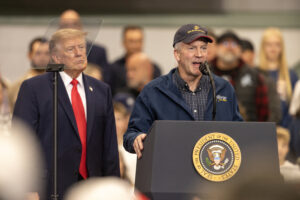

Wall Street rallied sharply on November 4, 2026, after Democrats won control of both chambers of Congress in the U.S. midterm elections, ending Republican control of the legislative branch and creating a divided government under President Donald Trump.
The election results initially triggered uncertainty across financial markets. However, investors quickly reversed course, sending major stock indexes higher as concerns about a prolonged political confrontation eased.
The rally reflected changing expectations about federal spending, business regulation, artificial intelligence and the direction of American economic policy. Dow Jones Industrial Average futures climbed 912 points, approximately 1.75%, before Wednesday’s opening bell.
S&P 500 futures increased 0.8%, while Nasdaq-100 futures recovered from an earlier decline of as much as 2.4% to gain 0.9%. The recovery accelerated after President Trump acknowledged the Democratic victories and indicated his willingness to accept the results.
His response helped reassure investors concerned about possible election disputes or prolonged political instability. By the end of Wednesday’s trading session, the Dow had gained approximately 3%, while the S&P 500 and Nasdaq Composite rose 1.6% and 1.4%, respectively.
The Democratic Party’s victories in both the House of Representatives and Senate represent a significant change in Washington’s political balance. With Republicans losing congressional control, the Trump administration will face greater legislative resistance during the remaining two years of the president’s term.
A Democratic Congress could increase scrutiny of corporate practices, challenge federal spending priorities and pursue investigations into major industries. However, substantial legislative changes may prove difficult because Republicans retain the presidency and Trump can veto legislation.
For investors, divided government creates both opportunities and uncertainty. Some analysts believe political gridlock could limit major policy changes, while others warn that disputes over government spending and taxation could disrupt financial markets.
The election results have introduced fresh uncertainty for technology companies investing heavily in artificial intelligence infrastructure. Democratic gains in states experiencing rapid data center expansion have intensified concerns about possible restrictions on new construction.
Investors are increasingly examining the electricity consumption, environmental consequences and financial sustainability of enormous computing facilities. Shares of Oracle and CoreWeave declined, reflecting concerns about businesses closely connected to AI infrastructure. Tesla and SpaceX also experienced selling pressure before the market opened.
The developments demonstrate how political decisions can influence the outlook for industries that have attracted billions of dollars in investment. While some technology companies struggled, other industries benefited from expectations of changing federal priorities.
Renewable energy stocks climbed as investors anticipated greater political support for clean energy initiatives. The Invesco Solar ETF gained approximately 5%, while several international renewable energy companies recorded substantial increases.
Healthcare companies also advanced. Molina Healthcare, Centene and UnitedHealth posted gains as investors assessed the potential implications of Democratic congressional leadership for healthcare policy. Walmart and Bank of America also moved higher, contributing to broader market optimism.
The election results influenced international financial markets. European stocks advanced, while Asian markets recovered from earlier declines. Gold prices strengthened as investors sought protection against economic uncertainty. Meanwhile, Treasury yields declined and oil prices weakened, reflecting changing expectations about inflation, economic growth and geopolitical developments.
These movements illustrate the global importance of American elections. Although the immediate market reaction was positive, significant questions remain about the future of federal economic policy.
Congressional disagreements could complicate spending negotiations, business regulation and efforts to address rising living costs. The technology sector will also face closer examination as policymakers debate the economic and environmental consequences of artificial intelligence.
For Wall Street, the Democratic victories have created a new political landscape. The challenge now is determining whether a divided government will encourage financial stability or introduce new obstacles for American businesses and investors.