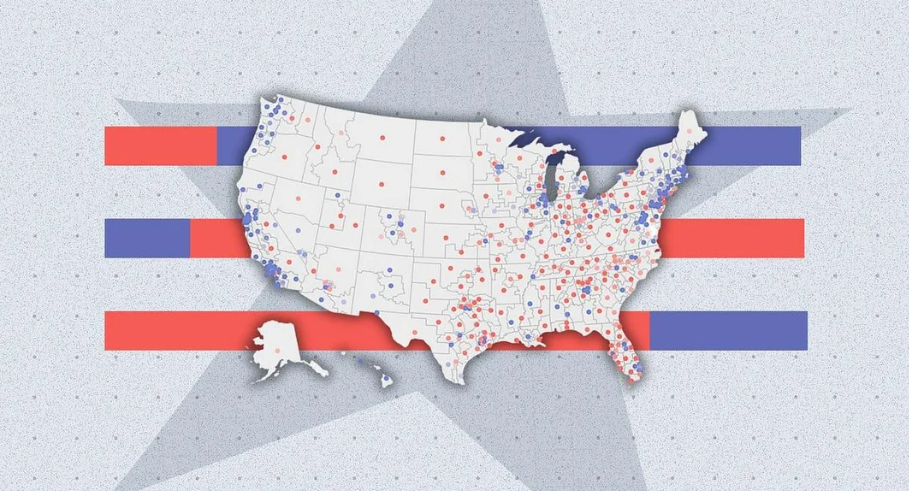
President Donald Trump’s ambitious effort to reshape congressional districts in favor of Republicans largely failed during the November 3, 2026, midterm elections, as a nationwide Democratic surge overwhelmed carefully redesigned electoral maps.
Seemingly, Republican-led states redrew congressional boundaries to improve the party’s chances in 15 U.S. House seats. However, Democrats won or led in most of those districts, undermining a strategy intended to protect the Republican majority.
The results demonstrate how shifting voter priorities can overcome even significant structural electoral advantages. Beginning in 2025, Trump encouraged Republican-controlled states to redraw congressional maps before the next scheduled redistricting cycle.
Normally, congressional districts are adjusted every ten years following the national census. The administration’s unusual mid-decade initiative sought to create additional Republican-leaning districts before an election expected to be difficult for the president’s party.
Texas became the centerpiece of the strategy, with Republicans targeting five Democratic-held seats. Florida pursued four additional opportunities, while Ohio targeted two. Alabama, Louisiana, North Carolina and Tennessee each contributed another potential Republican gain.
Together, these efforts were designed to strengthen Republican control of the House of Representatives. Texas Republicans experienced one of the most significant setbacks.
Their redesigned congressional map was intended to capitalize on Trump’s improved performance among Hispanic voters during the 2024 presidential election. However, Democratic Representatives Henry Cuellar and Vicente Gonzalez successfully defended their seats despite more Republican-friendly district boundaries.
Democrats also defeated Republican Representative Monica De La Cruz in South Texas, where musician Bobby Pulido won a closely watched contest. Another Democratic victory came in Texas’s 23rd Congressional District. Instead of expanding their congressional delegation, Texas Republicans were positioned to hold fewer seats than before the redistricting effort.
The outcome challenged assumptions that the political shifts observed in 2024 would necessarily continue into 2026. Similar disappointments emerged elsewhere. In Florida, Republicans failed to secure the substantial gains anticipated from their new map. Ohio Republicans also suffered unexpected losses despite district boundaries designed to favor their candidates.
North Carolina’s redistricting strategy created additional competitive races, potentially endangering Republican incumbents while attempting to defeat Democratic Representative Don Davis.
In Alabama, Democrat Shomari Figures successfully defended his seat despite changes intended to benefit Republicans. Louisiana remained unresolved, with a runoff election scheduled after no candidate secured a majority. These outcomes highlighted the uncertainty surrounding election strategies based primarily on previous voting patterns.
Democrats also pursued favorable congressional maps, particularly in states where they controlled the political process. California voters approved a measure allowing the state to redraw five districts in Democrats’ favor. The party appeared positioned to capture most or all of those seats.
In Utah, a court ruling created a more Democratic-friendly district, which Democrats subsequently won. Together, these developments helped counterbalance Republican attempts to gain congressional representation through redistricting.
The competing efforts also intensified debate over partisan gerrymandering and whether politicians should control electoral boundaries. The Republican setback reflected broader dissatisfaction among American voters.
Concerns about the cost of living, the economy, President Trump’s leadership and the war with Iran contributed to Democratic victories. Republican strategists had relied heavily on voting patterns from the 2024 presidential election.
However, changing political attitudes made those assumptions less reliable. The results suggest that district boundaries alone cannot guarantee victory when public opinion shifts substantially.
Despite their disappointing results, Republicans argue that the redesigned maps may have prevented even larger losses. Some strategists believe the districts could become more favorable during future elections.
Meanwhile, Democrats may pursue additional redistricting opportunities before the 2028 presidential election. Maryland voters approved a measure facilitating future congressional map changes, while Missouri voters rejected a Republican-backed redistricting proposal.
The 2026 midterms demonstrate that electoral engineering has limits. Although political parties can redraw congressional boundaries to improve their prospects, voters ultimately retain the power to overturn expectations and reshape the balance of government.