San Francisco has approved a controversial redevelopment project that will replace one of its most recognizable waterfront grocery stores with hundreds of apartments, marking a significant development in the city’s ongoing struggle to expand housing while preserving neighborhood character.
The proposal calls for demolishing the Marina Safeway, a supermarket that has served residents for 67 years, and constructing two residential towers containing 848 apartments. Approved by city planners on November 6, 2026, the project has sparked intense debate over housing affordability, environmental safety and the future of San Francisco’s historic Marina District.
Located at 15 Marina Boulevard, the Safeway opened in 1959 and became a neighborhood landmark. Over the decades, it earned the nickname “Dateway” because of its reputation as a popular meeting place for singles.
The supermarket also became part of San Francisco’s cultural identity, appearing in discussions of the city’s social history and inspiring references in Armistead Maupin’s Tales of the City.
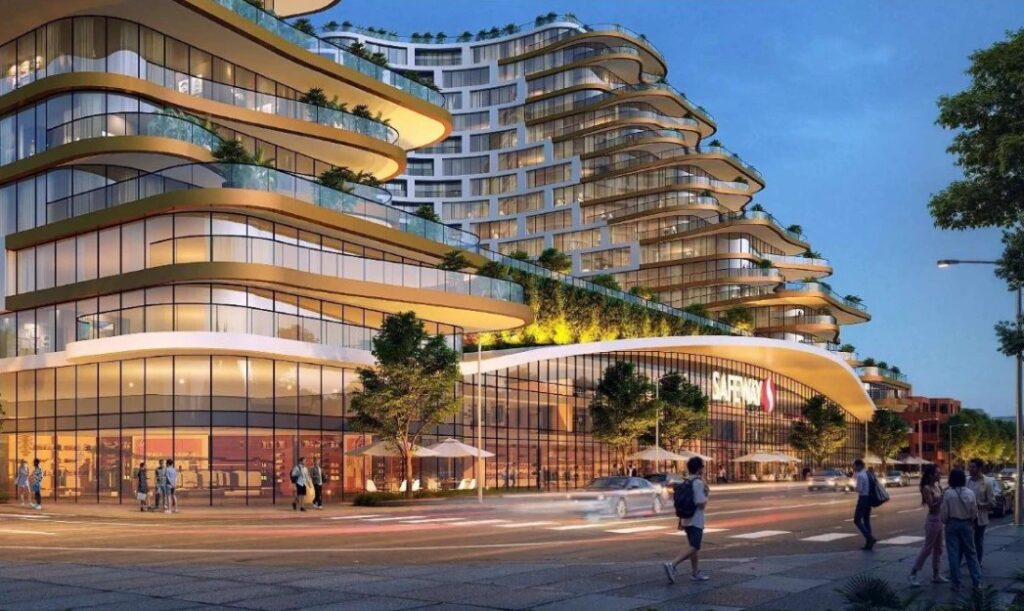
Its planned demolition represents a major transformation for a waterfront neighborhood traditionally characterized by relatively low-rise buildings and views of the Golden Gate Bridge. However, the supermarket will not disappear permanently. Developers intend to include a larger, modern Safeway on the ground floor of the new complex.
Developer Align Real Estate proposes two residential buildings reaching 22 and 18 stories. The development would contain 848 apartments, including 86 units reserved for lower-income households.
Ground-floor commercial space would provide additional opportunities for retail activity. Supporters argue that the project could help address San Francisco’s longstanding housing shortage, particularly in an affluent neighborhood where relatively little new residential construction has occurred.
By increasing the number of homes near existing businesses and public amenities, the development could accommodate additional residents without requiring expansion into undeveloped land. Despite its housing benefits, the project has faced opposition from neighborhood residents and local political leaders.
Mayor Daniel Lurie and District 2 Supervisor Stephen Sherrill have questioned whether the proposed towers are appropriate for the surrounding community.
Critics argue that buildings reaching 22 stories would dramatically alter the Marina District’s appearance and overwhelm its existing architectural character. Supporters counter that restricting development in desirable neighborhoods contributes to the city’s housing affordability crisis.
The disagreement reflects a broader challenge facing American cities: balancing the demand for additional housing against concerns about density, infrastructure and neighborhood preservation.
The project received streamlined approval under California Assembly Bill 2011, legislation designed to encourage residential construction on qualifying commercial properties. The law allows eligible developments to bypass certain traditional public hearings and environmental review procedures.
Align Real Estate also used California’s density bonus provisions to exceed existing height restrictions. These legal mechanisms significantly reduced the ability of local opponents to delay the proposal through conventional planning procedures. The controversy illustrates how statewide housing reforms are reshaping the balance of authority between developers, municipalities and neighborhood organizations.
Opponents have filed a federal lawsuit challenging the approval process. Their concerns include possible petroleum contamination beneath the supermarket, where a former Pacific Gas and Electric power plant once operated.
The lawsuit argues that environmental conditions should have been investigated more thoroughly before approval. The developer maintains that it will comply with applicable testing requirements.
City planners say additional assessments and any necessary cleanup can occur during later permitting stages. State regulators have indicated that known contamination does not currently present an exposure risk.
Although San Francisco has granted planning approval, demolition is not imminent. The developer must still obtain additional permits, resolve outstanding legal challenges and secure the financing necessary for construction. No official construction start date has been announced.
The project’s financial feasibility also remains uncertain because large residential developments face substantial construction costs. The Marina Safeway redevelopment highlights a defining question for modern American cities: how to create urgently needed housing while protecting environmental safety, community identity and the character of established neighborhoods.