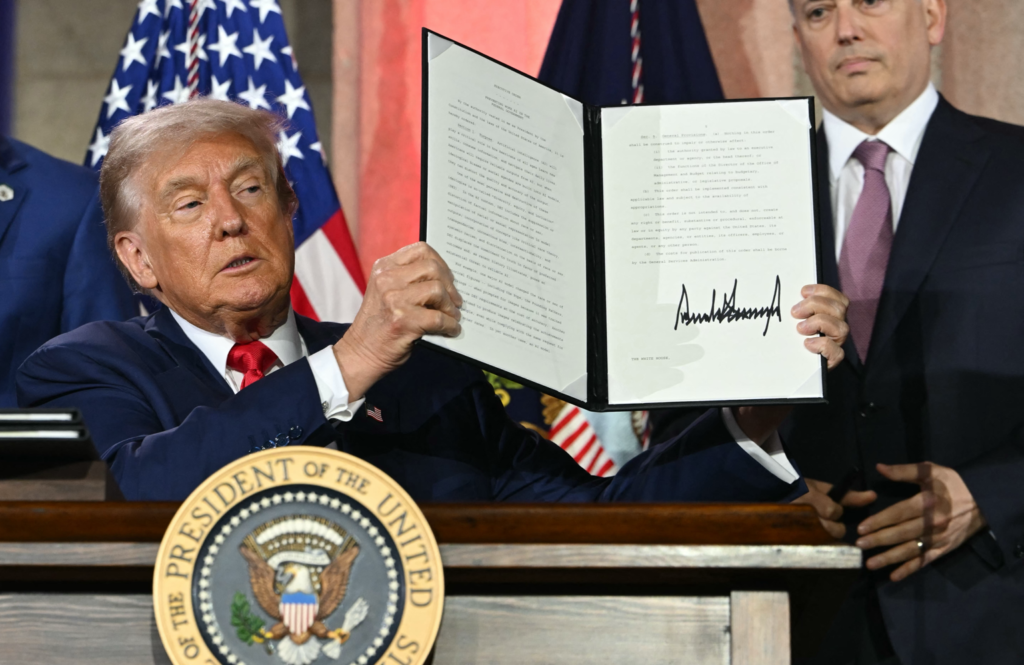
President Donald Trump has signed a new executive order aimed at increasing federal oversight of the most powerful artificial intelligence systems before they are released to the public. The order asks AI companies to give the administration access to advanced models 30 days before public release, allowing government officials to examine potential national-security and cybersecurity risks.
The order marks a notable shift for Trump, who had previously emphasized deregulation and U.S. dominance in the global AI race. Earlier in his second term, Trump rolled back parts of Biden-era AI policy and pushed a strategy focused on accelerating American innovation. But the rapid development of frontier models has raised concerns inside the administration that highly capable AI systems could be used to discover software vulnerabilities, strengthen cyberattacks, spread disinformation or assist hostile foreign actors.
The new order is also a compromise. A previous version reportedly would have required AI companies to give the government access 90 days before releasing their most advanced systems, but that plan was shelved after concerns that it could slow U.S. companies and weaken their position against China. The final version shortens the window to 30 days and frames the process as a voluntary review system rather than a strict licensing regime.
Under the framework, major frontier AI labs such as OpenAI, Anthropic and Google may allow selected federal agencies and trusted partners to test powerful models before public launch. The goal is to identify security problems early, especially models capable of helping users exploit software flaws or conduct cyber operations. The order also directs national-security and cybersecurity officials to coordinate with agencies and companies on vulnerabilities uncovered by new AI systems.
The policy reflects internal tensions inside the White House. Some officials, including Treasury Secretary Scott Bessent, have pushed for stronger oversight because of concerns about AI’s risks to financial markets, cybersecurity and national security. Others, including AI adviser David Sacks, have warned that too much regulation could damage American innovation and help foreign competitors. The final order tries to balance those positions by creating more government visibility without imposing hard restrictions on model releases.
Critics argue the order may still be too weak because participation is voluntary and because it does not create binding safety standards. They worry that powerful AI systems could still be released quickly without enough independent testing. Supporters say the order is a practical first step that gives Washington early warning of serious risks while avoiding heavy-handed regulation that could slow the industry.
The order also arrives as AI companies continue racing to release more powerful models. Anthropic, OpenAI and other labs are competing for enterprise customers, government contracts and global influence. At the same time, policymakers are trying to understand how to manage technology that could affect jobs, defense, cyberwarfare, elections and financial systems.
Overall, Trump’s executive order shows that even an administration focused on deregulation is now seeking more control over frontier AI. The message is clear: Washington does not want to stop the AI race, but it wants earlier access to the most powerful systems before they reshape the public, economic and security landscape.