President Donald Trump is embarking on a major diplomatic tour of Asia at one of the most challenging moments of his second presidency, facing political setbacks at home and growing controversy over national security concerns involving artificial intelligence giant Nvidia.
Trump’s November 2026 trip comes after Republicans suffered significant midterm election defeats, losing control of both chambers of Congress. The president hopes to secure economic agreements, strengthen American influence in Asia and pursue diplomatic breakthroughs with China and Russia.
However, domestic political weakness and disagreements within his administration could complicate those ambitions. The November elections dramatically changed Washington’s political landscape. Democrats’ congressional victories have strengthened their ability to investigate administration decisions and challenge Trump’s foreign policy priorities.
Although the president retains substantial executive authority, his negotiating partners must now consider whether future agreements could face congressional opposition. Political analysts suggest that Chinese President Xi Jinping and Russian President Vladimir Putin may see Trump’s weakened position as an opportunity to resist American demands.
The trip therefore represents both a diplomatic opportunity and a test of presidential influence. One of the most serious controversies involves Nvidia’s former chief executive, Jensen Huang, who resigned following revelations about his relationship with a businesswoman allegedly connected to Chinese intelligence.
The woman, Alice Huang, leads Megaspeed, a company under scrutiny over possible efforts to obtain restricted American AI chips. U.S. authorities are investigating whether advanced Nvidia technology reached China in violation of export controls.
The allegations remain under investigation, and the suspected intelligence connections have not been established as proven facts. Trump had received warnings about the relationship but maintained close ties with Nvidia’s former leader. The controversy has intensified scrutiny of the administration’s enforcement of semiconductor export restrictions.
Disagreements between Treasury Secretary Scott Bessent and Commerce Secretary Howard Lutnick have exposed divisions over how aggressively Washington should enforce technology restrictions.
Some officials favor stronger safeguards preventing Chinese companies from accessing advanced American processors. Others are concerned about economic consequences and the possibility of disrupting trade negotiations.
Potential measures include tighter restrictions on semiconductor resales and remote access to powerful computing systems outside China. These debates are especially sensitive because artificial intelligence has become central to economic competition and national security.
Trump also hopes to preserve the temporary trade agreement with China, which faces an important expiration deadline in January 2027. The administration wants greater certainty over tariffs, investment and access to critical minerals essential for advanced manufacturing.
However, previous meetings between Trump and Xi have failed to produce a comprehensive economic agreement. The latest negotiations could influence global supply chains, technology companies and international financial markets.
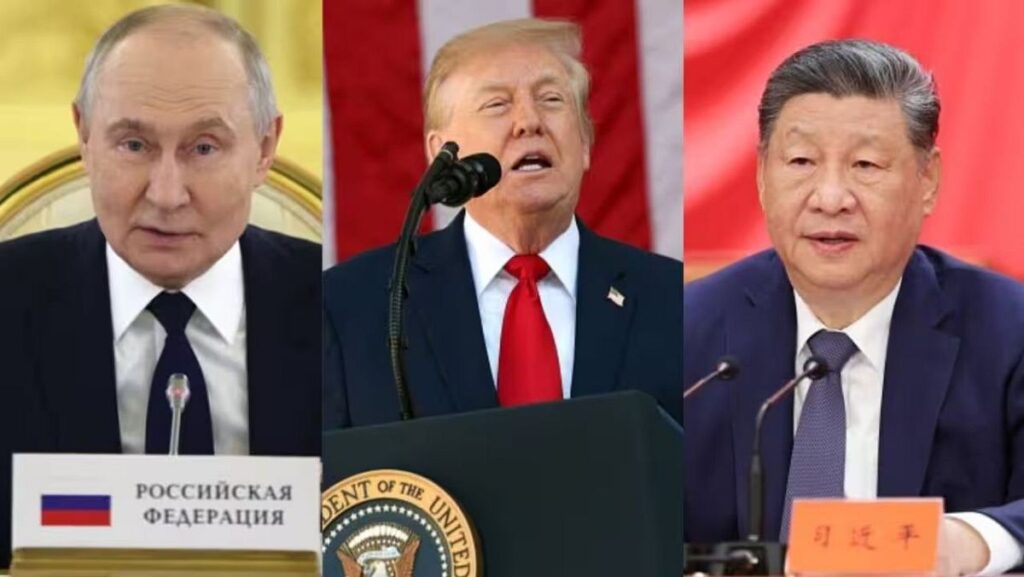
Trump’s itinerary includes meetings in the Philippines and China’s technology hub of Shenzhen. A planned three-way summit with Xi and Putin is expected to address nuclear arms control and broader strategic stability.
The leaders have different priorities. Trump wants progress on nuclear weapons restrictions, while Putin remains focused on Russia’s war in Ukraine. China has historically resisted participating in nuclear arms limitation agreements because its arsenal is smaller than those of the United States and Russia. These competing objectives make a major diplomatic breakthrough uncertain.
The visit comes as Washington confronts simultaneous challenges involving China, Russia, Iran and international trade. For Trump, successful negotiations could restore political momentum following the midterm defeats. Failure, however, could reinforce concerns about his administration’s diplomatic strategy and internal divisions.